Narwhal summer aggregations
See all narwhal pictures & images →
During the Arctic summer, narwhals congregate in coastal bays, inlets, and fjords spanning the Canadian Arctic and Greenland. As sea ice retreats and open water becomes accessible near the shore, multiple pods often converge in the same productive waters, sometimes forming aggregations of considerable size. These seasonal gatherings are a predictable feature of the narwhal's annual cycle, with individual populations returning to the same sites year after year, a pattern known as site fidelity.
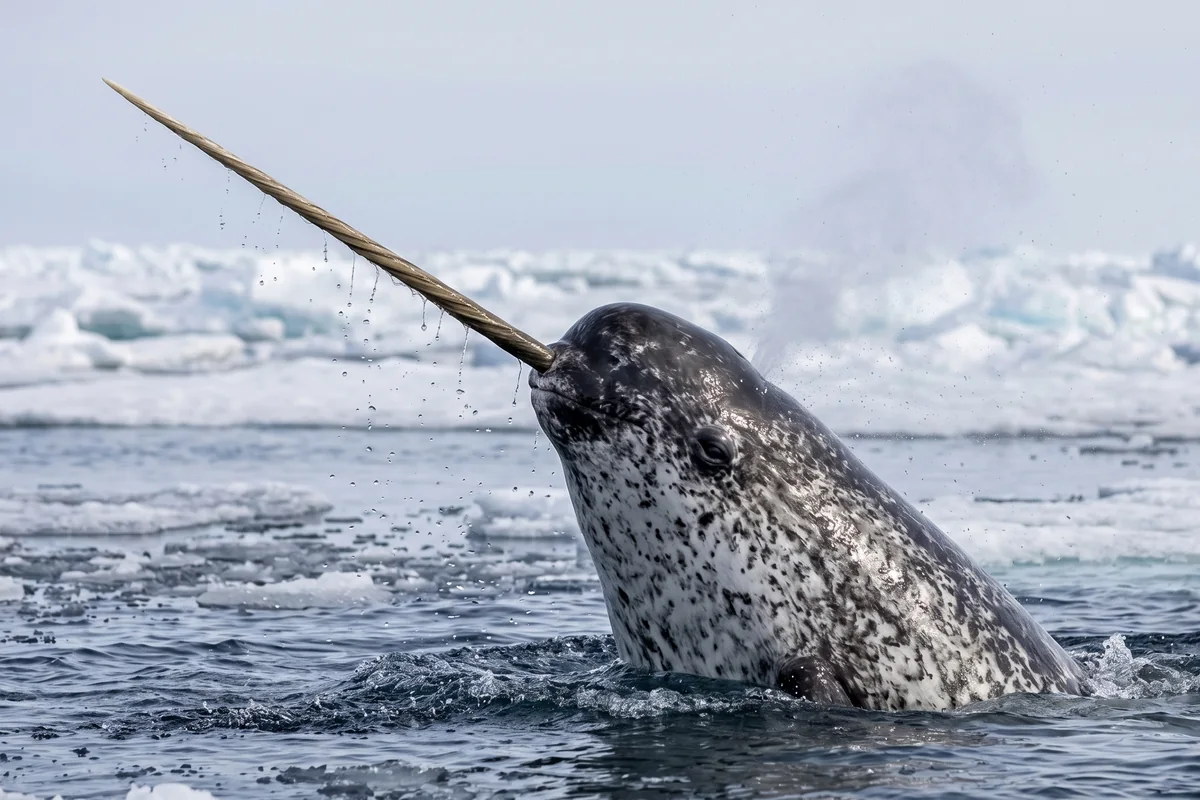
The ecological drivers of these summer aggregations are multifaceted. The availability of food in coastal waters during the ice-free season appears to play a central role, drawing narwhals to rich feeding grounds. Summer aggregation sites also provide suitable conditions for calves, offering shallow, protected waters where young whales can develop. Beyond subsistence and reproduction, researchers suggest that social interactions and mating behaviour may contribute to the timing and location of these gatherings.
The predictable nature of summer aggregation sites has made them culturally and scientifically significant. Inuit communities in the Arctic have long observed narwhals during these seasonal convergences, and modern research efforts continue to focus on these gatherings to monitor population health and behaviour. Understanding narwhal summer aggregations remains essential to conservation efforts in a rapidly changing Arctic environment.
Sources: IUCN Red List — Narwhal (Monodon monoceros); NOAA Fisheries — Narwhal. Educational information only. See our sources & fact-check policy.
Frequently asked questions
When of the narwhal summer aggregations?
Summer, as coastal sea ice breaks up
Where of the narwhal summer aggregations?
Bays and fjords of the Canadian Arctic and Greenland
More in Narwhal
Explore more Arctic wildlife
Compare the narwhal with the beluga, bowhead, orca, walrus, and polar bear in our quick-facts table.
Compare Arctic species →