Narwhal habitat & range
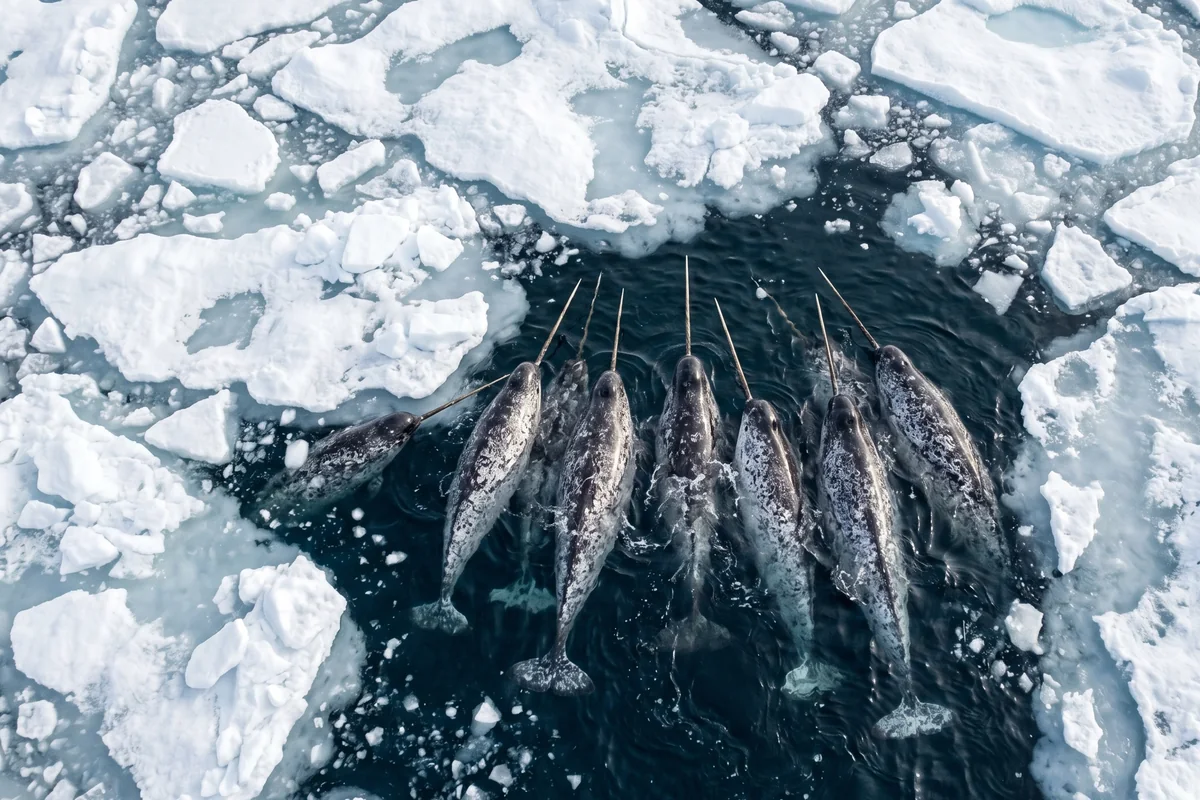
See all narwhal pictures & images →
Narwhale whales are generally seen in groups of twenty to thirty with varying combinations of male, female, and claves. Narwhals can be mainly found in the Atlantic and Russian portions of the Arctic [corrected from the original, which said "Antarctic"]. Individual narwhals are sometimes seen in the northern portions of the Hudson Bay and Strait, as well as the Baffin Bay, off of the eastern coast of Greenland, and in a relatively narrow area running along the northern end of Greenland to eastern Russia.
The narwhal whale population is estimated to be around 40,000, but has also been suggested to be as high as 50,000 individual whales.
Narwhals, being migratory, travel close to the coasts during the summer months, and travel farther away as the winder freeze starts to set in, and spend their winters in packed ice, and thrive in leads and small holes in the ice.
Updated & expanded — current sourced facts
The reference notes below were added by the Narwhal Whales editorial team to bring the original article up to date with current, sourced facts (IUCN Red List, NOAA Fisheries, NAMMCO). They supplement — and do not replace — the original article above. One factual correction has been applied to the original text above: narwhals are an Arctic species and do not occur in the Antarctic; the legacy article's "Antarctic" has been corrected to "Arctic." Modern surveys also put the global narwhal population well above the legacy estimate — on the order of 120,000+ mature individuals (IUCN: Least Concern), not the 40,000–50,000 cited in the original.
Narwhals are exclusively Arctic marine mammals, distributed across the high northern latitudes of the Atlantic sector. Their range centers on Baffin Bay, Davis Strait, Hudson Bay, and the Canadian Arctic archipelago, with significant populations around Greenland and smaller numbers in waters near Svalbard and the Russian Arctic. Unlike many migratory cetaceans, narwhals remain in Arctic waters year-round, their presence tightly linked to pack ice dynamics and the extreme seasonality of polar marine ecosystems.
These deep-diving specialists exhibit distinct seasonal movement patterns tied to ice conditions and food availability. During summer months, narwhals migrate into shallow coastal bays and fjords to feed and rest in open water. As autumn advances and ice consolidates, they shift to offshore regions where they spend winter among dense pack ice, exploiting leads—narrow cracks and openings in the frozen surface—to access prey and breathe. This intimate association with sea ice makes narwhals sensitive indicators of environmental change in Arctic waters.
Current population estimates place the global narwhal population at approximately 120,000 or more mature individuals, representing a substantial increase from earlier assessments that suggested 40,000 to 50,000 animals. This revised understanding reflects improved survey methods and monitoring across their Arctic range. The International Union for the Conservation of Nature (IUCN) lists the narwhal as Least Concern, recognizing the species' current demographic trajectory and stable status within its remote Arctic habitat.
This page updates and corrects an original narwhalwhales.com article with current, sourced facts.
Sources: IUCN Red List — Narwhal (Monodon monoceros); NOAA Fisheries — Narwhal; NAMMCO — Narwhal. Educational information only. See our sources & fact-check policy.
Frequently asked questions
Do narwhals live in the Arctic or Antarctic?
Narwhals live in the ARCTIC, in the cold waters of the far north around Greenland, Baffin Bay, and the Canadian Arctic. They are not found in the Antarctic.
Region of the narwhal habitat & range?
High Arctic (NOT Antarctic)
Core range of the narwhal habitat & range?
Baffin Bay, Davis Strait, Hudson Bay, around Greenland
Also found of the narwhal habitat & range?
Svalbard and the Russian Arctic in smaller numbers
More in Narwhal
Explore more Arctic wildlife
Compare the narwhal with the beluga, bowhead, orca, walrus, and polar bear in our quick-facts table.
Compare Arctic species →