Narwhal sounds and communication
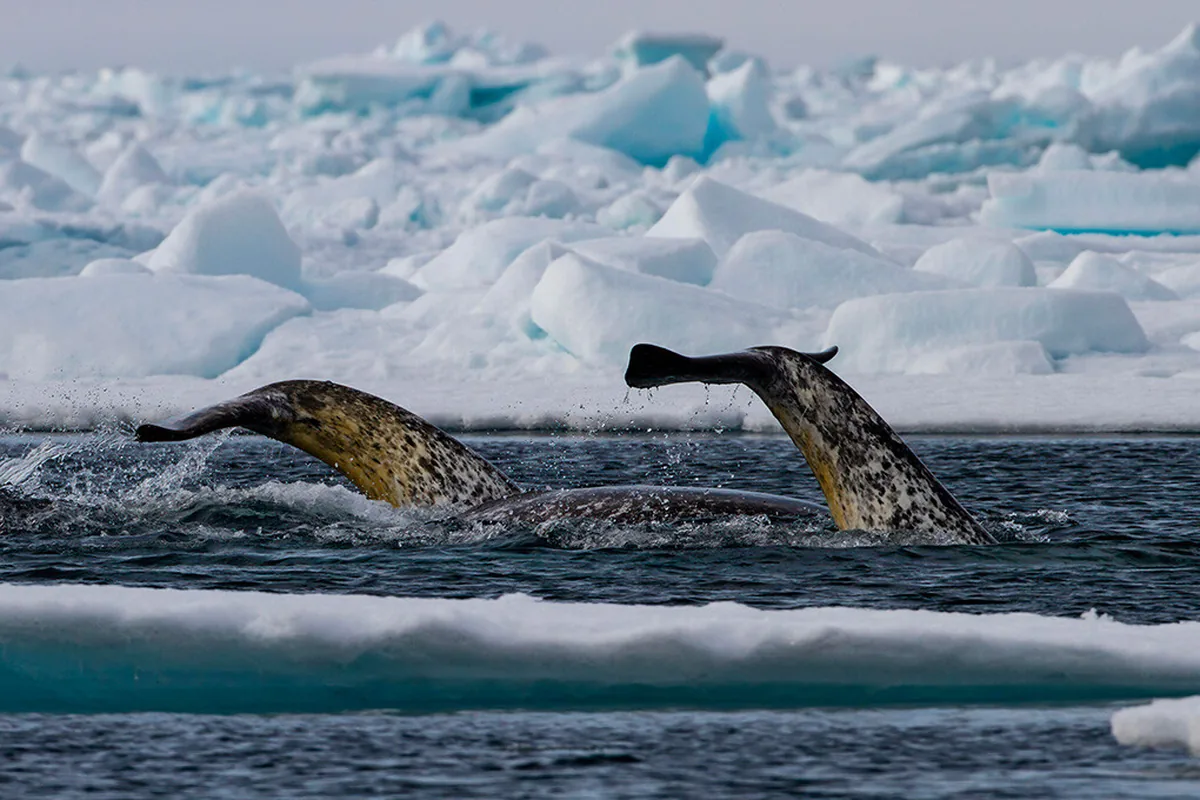
See all narwhal pictures & images →
Narwhals are highly vocal Arctic toothed whales that rely on sound to navigate and communicate in their ice-covered environment. These marine mammals produce three main types of vocalizations: clicks, whistles, and pulsed calls. Each serves a distinct function in the narwhal's life underwater.
Clicks function as a biological sonar system, allowing narwhals to echolocate in the darkness beneath sea ice. By emitting clicks and listening to the returning echoes, individual narwhals can navigate their habitat and detect prey. This echolocation ability is essential for survival in Arctic waters where light penetration is limited and ice cover restricts movement. Meanwhile, whistles and pulsed calls appear to facilitate social communication among pod members, helping individuals coordinate group movements and maintain social bonds.
Like other toothed whales, narwhals generate sound in their nasal passages and direct it through the melon—a fatty acoustic organ located in the forehead. This biological apparatus allows them to produce and focus their vocalizations effectively. In the cold, dark waters of the Arctic, these acoustic signals form a critical layer of pod cohesion, enabling groups of narwhals to stay coordinated despite limited visibility.
Sound represents one of the narwhal's most important survival tools, serving functions from basic navigation to complex social interaction in one of Earth's most extreme marine environments.
Sources: NOAA Fisheries — Narwhal; IUCN Red List — Narwhal (Monodon monoceros). Educational information only. See our sources & fact-check policy.
Frequently asked questions
Sound types of the narwhal sounds and communication?
Clicks (echolocation), whistles, pulsed calls
Where produced of the narwhal sounds and communication?
Nasal passages, focused through the melon
More in Narwhal
Explore more Arctic wildlife
Compare the narwhal with the beluga, bowhead, orca, walrus, and polar bear in our quick-facts table.
Compare Arctic species →