Narwhal population and stocks
See all narwhal pictures & images →
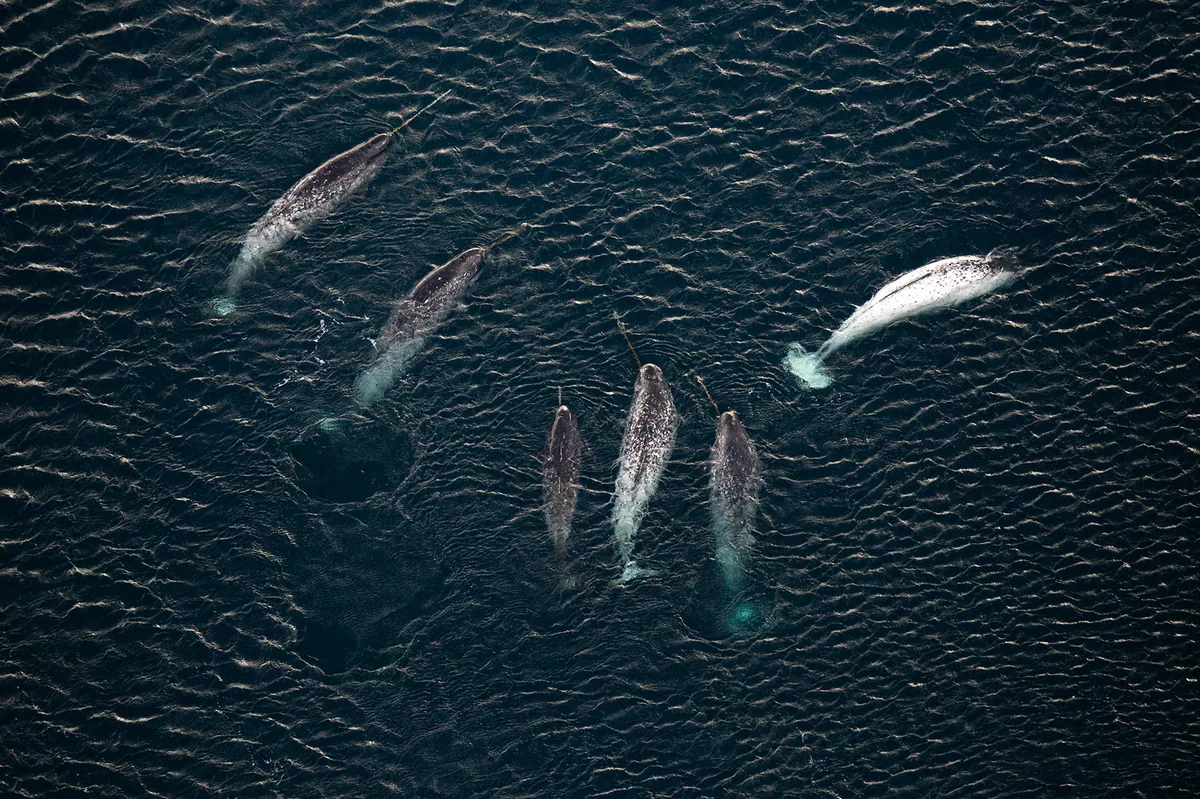
Narwhals are divided into several distinct populations, or stocks, identified by scientists on the basis of summer range and migration patterns. The most extensively studied stocks inhabit the Canadian Arctic, particularly around Baffin Island, while other significant populations occupy waters adjacent to Greenland. Smaller groups range eastward toward Svalbard and into the Russian Arctic. This spatial organization reflects the animals' predictable seasonal movements and helps researchers track the health and trends of individual populations across the Arctic.

Stock-based management has become essential to narwhal conservation because hunting pressure and environmental change do not affect all groups uniformly. A population concentrated in one region may face different risks—from commercial activity, climate shifts, or hunting intensity—than a geographically distant stock. Consequently, monitoring the species as a whole can obscure the status of smaller or more vulnerable groups. A stable total population count does not guarantee that every stock remains secure, making detailed assessment at the stock level a cornerstone of effective stewardship.
Narwhals are considered relatively numerous across their Arctic range, and no immediate extinction threat faces the species overall. Nevertheless, careful, ongoing stock-by-stock monitoring remains fundamental to long-term conservation. This granular approach allows researchers and managers to detect early warning signs in individual populations and to tailor protection measures to regional conditions and local pressures. Such vigilance helps ensure that narwhals continue to thrive in their Arctic habitat.
Sources: IUCN Red List — Narwhal (Monodon monoceros); NOAA Fisheries — Narwhal. Educational information only. See our sources & fact-check policy.
Frequently asked questions
Why stocks matter of the narwhal population and stocks?
Pressures differ between populations
Main regions of the narwhal population and stocks?
Canadian Arctic, Greenland, eastern Atlantic Arctic
More in Narwhal
Explore more Arctic wildlife
Compare the narwhal with the beluga, bowhead, orca, walrus, and polar bear in our quick-facts table.
Compare Arctic species →