Narwhal breathing and blowholes
See all narwhal pictures & images →
Narwhals are air-breathing marine mammals that depend entirely on atmospheric oxygen, a fundamental requirement they share with all cetaceans. To breathe, narwhals surface and draw air through a single blowhole positioned on the crown of the head. In the open ocean, this behavior presents no obstacle, but the narwhal's Arctic habitat transforms respiration into a constant logistical challenge. Beneath the frozen surface of Arctic seas, solid pack ice blocks direct access to the atmosphere, forcing narwhals to navigate between gaps, cracks, and leads in the ice sheet to reach breathable air.
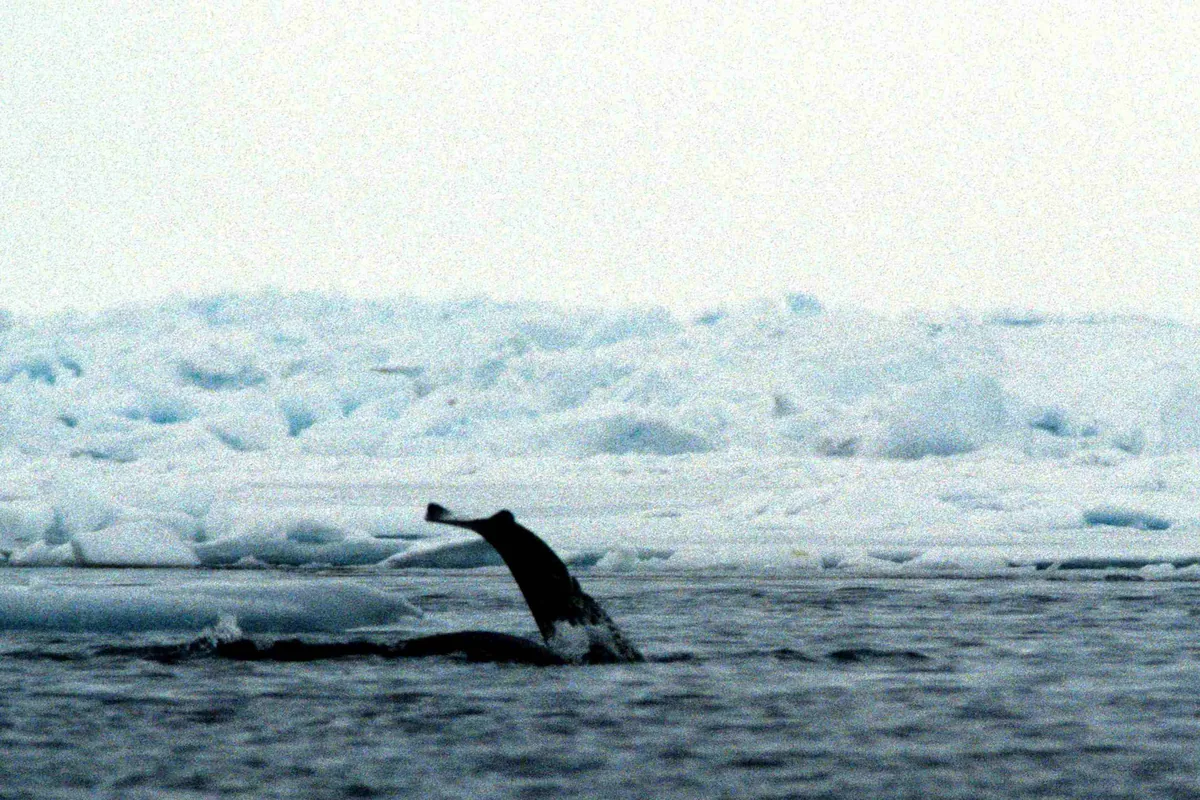
The narwhal's body is remarkably adapted to exploit these limited openings. Unlike many whale species, narwhals lack a dorsal fin on their backs, a characteristic that allows them to surface through narrow spaces in the ice without risk of obstruction or injury. This streamlined profile is essential to survival in an environment where access points may be separated by considerable distance. Narwhals undertake extended foraging dives to reach food on the seafloor, traveling between widely spaced ice openings during these excursions. Between dives, they spend time near the surface, breathing and recovering before the next descent.
The availability of reliable breathing holes shapes narwhal distribution and seasonal movement across the Arctic. Their dependence on ice openings explains why these animals concentrate near the dynamic edges of pack ice, where fracturing and movement create accessible leads. Ice conditions thus exert powerful influence over narwhal habitat use and migration patterns throughout the year.
Sources: NOAA Fisheries — Narwhal; IUCN Red List — Narwhal (Monodon monoceros). Educational information only. See our sources & fact-check policy.
Frequently asked questions
How they breathe of the narwhal breathing and blowholes?
Air through a blowhole at the surface
Under-ice access of the narwhal breathing and blowholes?
Cracks, leads, and openings in the ice
More in Narwhal
Explore more Arctic wildlife
Compare the narwhal with the beluga, bowhead, orca, walrus, and polar bear in our quick-facts table.
Compare Arctic species →